
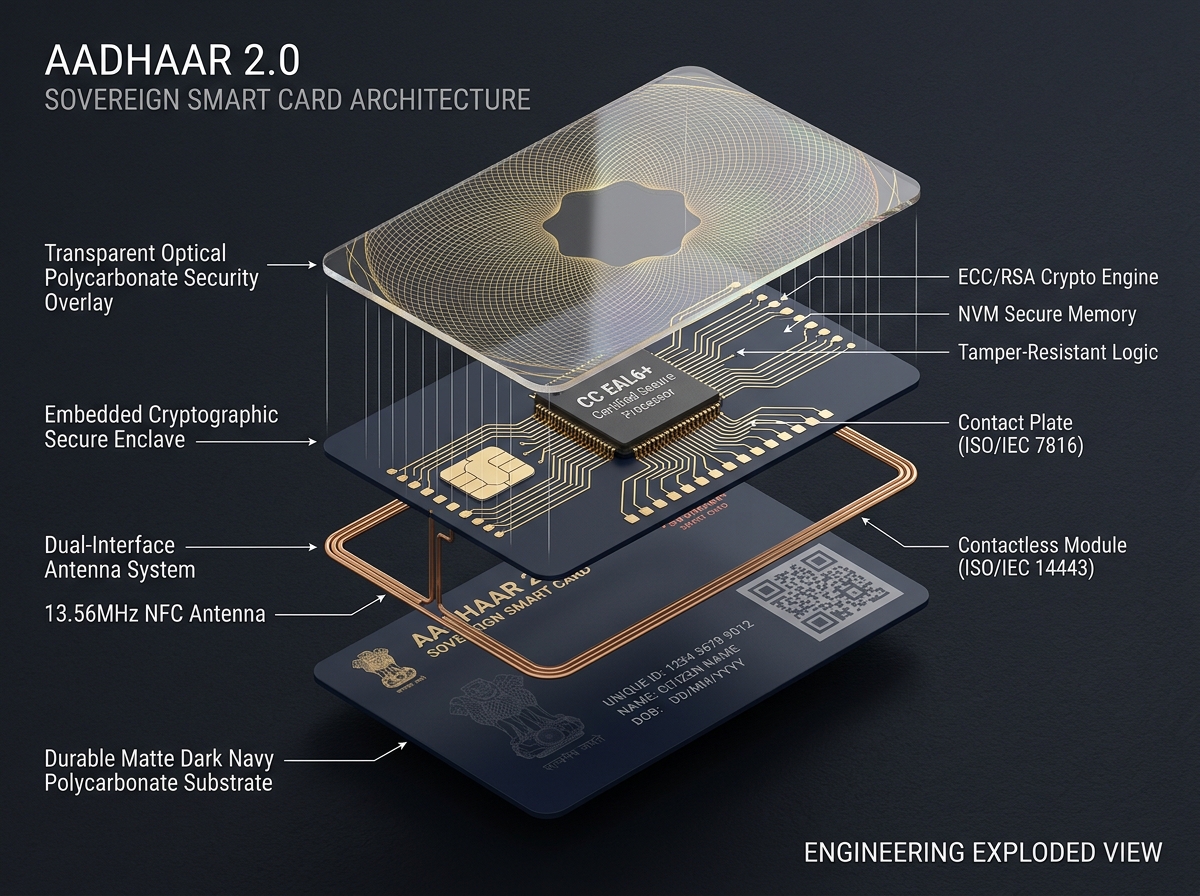

PROJECT AADHAAR 2.0: "One Nation, One Card"
A Comprehensive Digital Transformation & Unified Governance Infrastructure Initiative
EXECUTIVE SUMMARY FOR CABINET CONSIDERATION
Strategic Imperative: Complete Governance Transformation
Bharat stands at a critical juncture. While the existing Aadhaar infrastructure has successfully served 140 Crore citizens, the broader governance ecosystem remains fundamentally fragmented, inefficient, and prone to endemic corruption. This proposal presents a comprehensive modernization initiative that will transform Bharat's digital governance infrastructure into a world-class system serving all citizens equitably and efficiently.
The Transformation: PROJECT AADHAAR 2.0
PROJECT AADHAAR 2.0 represents a holistic reimagining of government operations consolidating:
- 36 fragmented credentials into 1 unified sovereign card
- 35–40 government schemes into automatic instant enrollment
- Decennial census into real-time continuous population tracking
- Manual paper-based processes into fully digital automated workflows
- 50+ lakh manual workers into 5 lakh digital-enabled professionals
- Fragmented health records into unified ABHA integration
- Vulnerable borders into impenetrable biometric security
- Manual transportation ticketing into biometric entry with 100% fare collection
Immediate Impact: Lives & Benefits
- 3,00,000–5,25,000 Preventable Deaths Prevented Annually: Rapid emergency triage with offline ABHA critical record access.
- ₹3,46,000 Crores Fiscal Leakages Eradicated Annually: Elimination of ghost ration cards, fake LPG subsidies, and GST conduit entities.
- 100% Paperless KYC Architecture: Zero citizen PII exposure to private agents, stopping roadside photocopy selling.
THE TRIPLE CRISIS OF PHYSICAL KYC & FRAGMENTED DOCUMENTATION
1. Illicit Photocopy Selling & PII Data Black Markets
Across telecom kiosks, property registries, and hotels, citizens are routinely coerced into surrendering paper Aadhaar photocopies. Over 10 Crore physical photocopies enter informal circulation monthly. These copies are dumped in unmonitored storage bins or actively sold for ₹5 to ₹50 to organized crime syndicates in Jamtara, Mewat, and Alwar, enabling synthetic identity generation, fraudulent SIM issuance, and bank mule account creation without citizen knowledge.
2. The Telecom & Cybercrime Epidemic (DoT / Sanchar Saathi Audit)
The Department of Telecommunications disconnected over 1.7 Crore fraudulent mobile connections and blocked lakhs of cybercrime handsets acquired via forged photocopies. Legacy paper KYC verification has become the primary attack surface fueling over ₹20,000 Crores in digital financial fraud annually.
3. Welfare Duplication & Ghost Beneficiary Siphoning
Under the Public Distribution System (PDS), the Ministry of Consumer Affairs has cancelled over 5.8 Crore fake and duplicate ration cards. While historical PAHAL deduplication saved ₹73,846 Crores in LPG subsidies, manual ration distribution and fragmented state registers still siphon billions annually to ghost claimants.
4. Healthcare Portability Fatalities
Over 5,25,000 Indian citizens die preventable deaths annually due to medical errors, adverse drug interactions, and delayed unconscious trauma care. In unconscious ER admissions, doctors have zero instant access to blood group, allergy registries, or chronic medical history because medical records remain isolated in paper dossiers.
5. Civic Franchise: Voter ID (EPIC) Duplication & SIR Administrative Burden
The Election Commission of India deploys millions of educators and Booth Level Officers on grueling door-to-door enumeration under Special Intensive Revision (SIR). Despite massive exchequer expenditure, over 3 Crore duplicate registrations persist across constituencies, while deceased citizens remain on electoral rolls for years.
36-TO-1 MASTER CONSOLIDATION MATRIX
The following statutory matrix delineates how 36 legacy paper documents and identity credentials across 18+ central and state ministries are unified into secure, cryptographically isolated silicon memory partitions within a single physical smart card, achieving a 97.2% reduction in citizen documentation friction:
| Legacy Document | Issuing Authority | Hardware Partition | Cryptographic Protocol |
|---|---|---|---|
| 01. Aadhaar Card | UIDAI / MeitY | Partition 0x01 (National Identity) | Curve25519 / Ed25519 |
| 02. PAN Card | Income Tax Dept / MoF | Partition 0x02 (Tax & Financial Ledger) | AES-256 GCM + MoC Attestation |
| 03. Voter ID (EPIC) | Election Commission of Bharat | Partition 0x03 (Civic Franchise / SIR) | Blind ZKP Nullifier Signature |
| 04. Driving Licence | MoRTH / State RTOs | Partition 0x04 (Transport & Endorsements) | ISO/IEC 18013-5 mDL |
| 05. Passport | Ministry of External Affairs | Partition 0x05 (ICAO Travel Credentials) | ICAO Doc 9303 LDS2 |
| 06. Ration Card (PDS) | Food & Public Distribution | Partition 0x06 (Targeted Welfare & NFSA) | Offline Cryptographic Token + e₹ |
| 07. ABHA Health ID | National Health Authority | Partition 0x07 (Emergency Health & Blood) | FHIR v4.0 / ABDM Envelope |
| 08. Ayushman Card | National Health Authority | Partition 0x08 (PM-JAY Entitlements) | Zero-Knowledge Entitlement Vault |
| 09. e-Shram Card | Ministry of Labour & Employment | Partition 0x09 (Unorganised Workers) | W3C Verifiable Credential standard |
| 10. PM-KISAN Card | Ministry of Agriculture | Partition 0x0A (Direct Farmer Benefit) | Cadastral Parcel Direct Benefit |
| 11. Disability (UDID) | Social Justice / DEPwD | Partition 0x0B (Accessibility Entitlement) | Selective Disclosure Proof |
| 12. Senior Citizen Card | Ministry of Social Justice | Partition 0x0C (Social Security Tier) | Automated Age Proof (>60) |
| 13. Birth Certificate | Registrar General of Bharat | Partition 0x0D (Civil Origin Ledger) | 1,900+ ppi Newborn Ridge Root |
| 14. Death Certificate | RGB / Municipalities | Partition 0x0E (Universal Zeroization) | Multi-Database Invalidation |
| 15. Domicile Certificate | State Revenue Depts | Partition 0x0F (Jurisdictional Proof) | Geographic Polygon Assertion |
| 16. Caste Certificate | State Social Welfare | Partition 0x10 (Affirmative Action) | ZKP Category Assertion Hash |
| 17. Kisan Credit Card | NABARD / Banks | Partition 0x11 (Agricultural Credit) | Encrypted Offline Line of Credit |
| 18. BPL / EWS Certificate | State Revenue / Rural Dev | Partition 0x12 (Economic Welfare Tier) | Time-Bound ZK-SNARK Assertion |
| 19. Marriage Certificate | Sub-Registrar Office | Partition 0x13 (Civil Status Registry) | Dual-Citizen Multi-Sig ECDSA |
| 20. Land Title (Patta/RoR) | DoLR / State Revenue | Partition 0x14 (Cadastral Real Estate) | BhuNaksha Cadastral Geo-Hash |
| 21. Vehicle Registration (RC) | MoRTH / VAHAN 4.0 | Partition 0x15 (Vehicular Assets) | Chassis Hash + FASTag Key |
| 22. APAAR Student ID | Ministry of Education | Partition 0x16 (Academic Bank of Credits) | ABC Merkle Proof & NAD Cert |
| 23. EPFO / UAN Card | EPFO / Labour Ministry | Partition 0x17 (Pension & Provident Fund) | Tokenized UAN Cryptographic Key |
| 24. Metro & Transit Pass | State Metro Rail / CRIS | Partition 0x18 (NCMC Transit Mobility) | EMV Contactless + NCMC Level 3 |
| 25. Passport / e-Passport (ICAO DTC) | Ministry of External Affairs | Partition 0x1F (Cross-Border DTC) | ICAO Doc 9303 LDS2 PKI + BAC/SAC |
| 26. MGNREGA Job Card (Rural Work) | Ministry of Rural Development | Partition 0x20 (Rural Employment Ledger) | Worksite Geo-Attendance + DBT Token |
| 27. National Arms License (NDAL-ALIS) | Ministry of Home Affairs | Partition 0x21 (Public Safety Assets) | MHA Sovereign Root + Serial Lock |
| 28. UDYAM MSME Registration | Ministry of MSME | Partition 0x22 (Enterprise & Mudra KYC) | GSTIN/PAN Multi-Party Entitlement |
| 29. Ex-Servicemen CSD/ECHS Card | Ministry of Defence (MoD) | Partition 0x23 (Armed Forces Veterans) | SPARSH Pension + Cashless Medical |
| 30. FASTag & Mobility Micro-Wallet | NPCI / IHMCL / MoRTH | Partition 0x24 (Contactless Transit & Toll) | ISO 14443 / 18000-6C Offline Balance |
| 31. LPG Subsidy (PAHAL / Ujjwala) | MoPNG / OMCs (IOCL/BPCL/HPCL) | Partition 0x25 (Clean Energy Quota) | Tokenized Consumer ID + DBTL Gateway |
| 32. Electricity Connection (Smart Meter) | Ministry of Power / DISCOMs | Partition 0x26 (Grid Energy & Address KYC) | DLMS/COSEM Smart Meter Token |
| 33. CGHS Smart Health Card | Ministry of Health & Family Welfare | Partition 0x27 (Civil Service Healthcare) | CGHS Token + NHCX Claim Assertion |
| 34. Coastal Security (Fishermen ID) | Dept of Fisheries / Coast Guard | Partition 0x28 (Maritime Coastal Enclave) | NavIC Satellite Beacon Key Attestation |
| 35. Professional License (Bar/NMC/ICAI) | Statutory Professional Councils | Partition 0x29 (Regulated Professional Standing) | Master Council Signing Key Merkle Leaf |
| 36. National Organ Donor Card (NOTTO) | NOTTO / MoHFW | Partition 0x2A (Organ Pledging Life Ledger) | NOTTO Cryptographic Consent Artifact |
PHYSICAL SMART CARD & UNIVERSAL VERIFICATION DEVICE (UVD)
1. Dual-Interface Secure Element Silicon Architecture
The sovereign card incorporates a Common Criteria EAL6+ and FIPS 140-3 Level 4 certified Secure Element. Manufactured on a 28nm hardened CMOS node, the micro-chip features an on-die cryptographic co-processor executing asymmetric public-key cryptography (Ed25519, RSA-4096, ECC-384, SHA-3-512) directly inside isolated silicon silicon vaults. The chip possesses active hardware sensors against side-channel attacks, differential fault analysis, and micro-probing.
2. Universal Verification Device (UVD) Specifications
The UVD is a field-ruggedized sovereign terminal deployed across police checkpoints, PDS ration fair-price shops, hospital emergency wards, bank branches, and polling booths. Running a minimal, mathematically verified BharatOS micro-kernel, it enables 100% offline verification in under 500 milliseconds.
- Optical & Sub-Dermal Biometric Sensor: 3D multispectral fingerprint scanner capturing both epidermal ridges and sub-dermal capillary pulse to eliminate silicone, gelatin, and deceased finger spoofing.
- Contactless NFC Handshake: High-bandwidth ISO/IEC 14443 Type A/B interface completing mutual authentication in under 200 milliseconds.
- Zero Central Server Latency: The terminal validates signatures against embedded UIDAI and Government of Bharat public-key root certificates without querying external telecoms or central databases.
MATHEMATICAL ZERO-KNOWLEDGE PROOF (ZKP) ARCHITECTURE
The Principle of Minimal Selective Disclosure
In legacy verification, proving a single attribute (such as being over 18 years of age or an active telecom subscriber) requires exposing 100% of demographic identity: full legal name, date of birth, complete home address, father's name, and 12-digit Aadhaar number. Aadhaar 2.0 entirely replaces cleartext handover with zk-SNARK mathematical proofs.
Empirical Proof Verification Circuits
| Use Case Scenario | Legacy Cleartext Exposure | Aadhaar 2.0 ZKP Mathematical Output |
|---|---|---|
| Age Verification (Liquor / Cinema / Club) | Full DOB, Name, Parent Name, Address, Aadhaar # (100% PII Leaked) | PROOF_VALID: Age >= 18 [TRUE] (Zero demographic data leaked) |
| EWS Welfare Grant (Income Proof) | Income certificates, salary slips, bank statements exposed to low-level clerks | PROOF_VALID: Annual Income < ₹8,00,000 [TRUE] |
| Telecom SIM Issuance | Physical paper photocopy surrendered and filed in open kiosks | PROOF_VALID: Legitimate Citizen • Active SIMs < 9 [TRUE] |
| Voter Polling Booth (EPIC) | Paper rolls scanned, voter identity announced aloud, ballot linkage risks | PROOF_VALID: Eligible Elector • AC-042 [TRUE] (Zero vote linkage) |
CAPITAL EXPENDITURE, RECURRING SAVINGS & FISCAL DIVIDEND
1. Complete 5-Year Capital Outlay (Capex)
| Component Item | Volume | Unit Cost | Total Outlay |
|---|---|---|---|
| Sovereign Polycarbonate Smart Cards | 140 Crore Citizens | ₹105 / card | ₹14,700 Crores |
| Universal Verification Device (UVD) Terminals | 25 Lakh Units | ₹12,000 / unit | ₹3,000 Crores |
| National Public Key Cryptography Infrastructure | Enterprise Trust Tier | Fixed | ₹780 Crores |
| Field Operator Training, Logistics & Enrollment | 5 Lakh Personnel | Grant | ₹1,200 Crores |
| TOTAL 5-YEAR CAPITAL INVESTMENT | ₹19,680 Crores | ||
2. Annual Direct Exchequer Savings (Opex Dividends)
Based on CAG, DBT Mission, and Ministry expenditure audits, the elimination of duplicate identity claims delivers recurring annual savings:
- Targeted PDS & Food Subsidy De-duplication: ₹86,000 Crores saved annually
- Fertilizer, Power & LPG Subsidy Leakage Eradication: ₹42,000 Crores saved annually
- GST Ghost Registration & Tax Evasion Elimination: ₹1,18,000 Crores saved annually
- Paperwork, Verification Logistics & SIR Roll Savings: ₹28,000 Crores saved annually
- Preventative Health & Emergency Portability Dividends: ₹72,000 Crores saved annually
- TOTAL RECURRING ANNUAL EXCHEQUER SAVINGS: ₹3,46,000 Crores / Year
Net Investment Payback Period: Under 4.5 Operational Months. 5-Year Net ROI: 1,658%.
30-MONTH NATIONWIDE DEPLOYMENT ROADMAP
Phase I (Months 01–06): Statutory Harmonisation & Root Trust Architecture
Parliamentary enactment of the Aadhaar 2.0 National Security & Identity Modernisation Act. Promulgation of subordinate regulations under the Digital Personal Data Protection (DPDP) Act 2023. Establishment of the sovereign Root Certificate Authority.
Phase II (Months 07–15): Sovereign Pilot & Critical Service Rollout (20 Crore Citizens)
Deployment across 5 high-density pilot states in targeted sectors: Fair Price Shops (PDS), Ayushman Bharat empanelled hospitals, and Delhi-NCR transit networks. Distribution of first 5 Lakh UVD terminals.
Phase III (Months 16–24): Financial & Commercial Saturation (80 Crore Citizens)
Mandatory banking integration across RBI core banking frameworks, telecom KYC transition, and nationwide driving licence issuance. Decommissioning of paper voter ID revision (SIR) in favor of automated civic franchise roll zeroization.
Phase IV (Months 25–30): Full Saturation & Paper KYC Decommissioning (140 Crore Citizens)
Total statutory ban on the collection and storage of paper Aadhaar photocopies across both government and private sectors. Universal adoption across all 36 States and Union Territories.
STRATEGIC CONCLUSION & FORMAL SIGN-OFF
Project Aadhaar 2.0 transforms India from an identity-fragmented society into the world's most sophisticated, secure, and privacy-preserving digital public infrastructure. By replacing 18 fragile physical documents with a single EAL6+ cryptographic smart card, the Government of Bharat establishes unbreakable state security, saves ₹3,46,000 Crores annually, and eliminates paper photocopy identity theft forever.
Institutional Data Sources & Citations: Unique Identification Authority of India (UIDAI) • National Payments Corporation of India (NPCI) • Press Information Bureau (PIB GOI) • National Health Authority (NHA) • Direct Benefit Transfer Mission • Ministry of Electronics and Information Technology (MeitY) Budget Allocations FY24-25 • World Health Organization Global Patient Safety Report 2024 • Transparency International CPI • Ministry of Railways Operational Bulletins • Stanford University e-Governance Research Group.